




Day 1
![Fort-de-France]()

Fort-de-France

MSC Cruises may be headquartered in Switzerland, but the ambience onboard its 23 ships is very much Italian owing to its owners, the Aponte family.
Ships feature a two-storey Mediterranean-style promenade and Instagram-worthy glass staircases filled with Swarovski crystals.
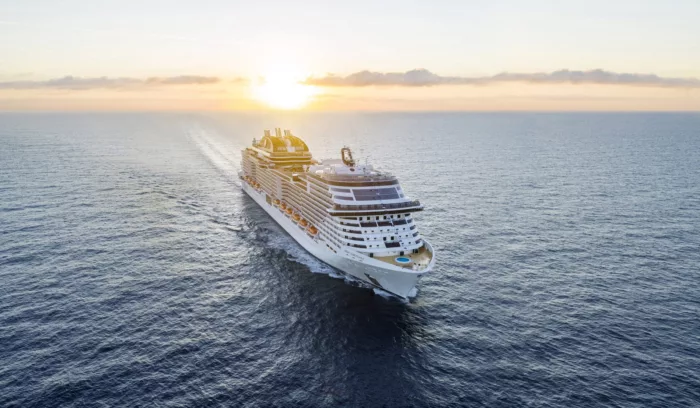
The line’s flagship is the 6,327 passenger MSC Euribia, which is MSC's second ship to run on liquefied natural gas.
Welcome to Ponta Delgada, where the echoes of its maritime past whisper tales of exploration and discovery. Here, amidst the gentle waves of the Atlantic Ocean, cruise lines anchor to unveil the hidden gems of Portugal's Azores archipelago. Set against a backdrop of lush greenery and volcanic landscapes, Ponta Delgada offers a climate that dances between subtropical and temperate, creating an ideal setting for leisurely exploration. Cruise-goers seeking an authentic escape from the ordinary will find themselves immersed in the vibrant local culture, where quaint cobblestone streets lead to bustling markets and charming cafes. As the gateway to S Miguel Island, Ponta Delgada boasts a unique blend of Old World charm and modern allure. A testament to its volcanic origins, visitors can bathe in the natural hot springs of Ferraria, a rejuvenating experience unlike any other.
View moreIn the annals of maritime lore, Lisbon stands as a testament to resilience, having weathered centuries of conquest and exploration. Its labyrinthine streets whisper tales of Moorish conquests and Age of Discovery triumphs, each cobblestone a silent witness to the city's rich past. Beneath the warm Mediterranean sun, Lisbon exudes an undeniable charm, drawing travelers seeking an authentic escape from the beaten path. From its vibrant neighborhoods to its serene waterfront, Lisbon offers a glimpse into Portugal's soul, where fado music reverberates through alfresco cafes, and the aroma of freshly baked pasts de nata fills the air, tempting even the most seasoned voyagers.
View moreAt first glance, Le Havre looks strikingly different from other stops along the Seine. Much of the city was destroyed during World War II, and its post-war reconstruction was led by the architect Auguste Perret, whose bold use of concrete and symmetry has since earned Le Havre UNESCO World Heritage status.What makes Le Havre interesting is precisely this contrast: the clean lines of its modernist layout set against the windswept Normandy coast. Perret’s legacy is seen in landmarks like the Church of St Joseph with its lantern tower.Le Havre is also a gateway to Normandy’s beaches and countryside. Some cruises include excursions from here to Étretat’s chalk cliffs, the D-Day Landing sites or inland to Rouen or Honfleur.
View more



Log in to continue


