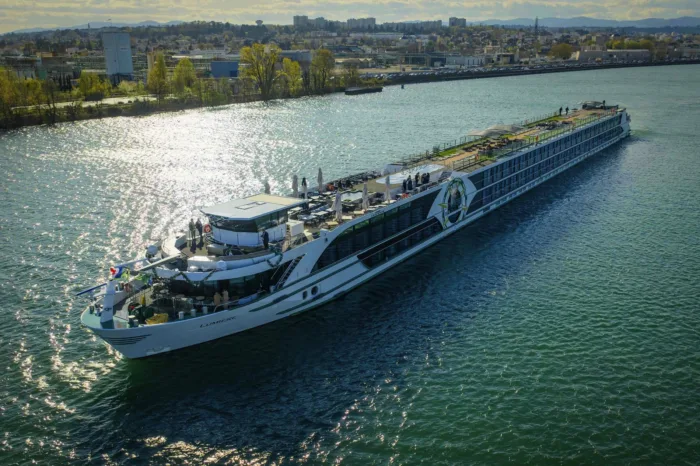
Tauck is a super-premium river cruise line offering small, intimate sailings on the waterways of Europe.
The cruise line launched in 1992, offering luxurious and all-inclusive river cruises on the likes of the Danube, Rhine and Rhone.
With many awards under its belt, the cruise line owns it when it comes to European river cruising, heading away from crowded tourist hotspots and off the beaten track.
Read moreCannes, famed for its opulent film festivals, welcomes travelers with a storied past steeped in glamour and luxury. Bask in the Mediterranean sunshine along its golden beaches, where celebrities once strolled and paparazzi snapped. The Mediterranean climate, with its mild winters and sun-drenched summers, offers a respite from harsher climates, inviting cruisegoers to savor alfresco dining and leisurely promenades. Beyond the glitz of the Croisette lies a vibrant city brimming with authentic French charm, from bustling markets to quaint cobblestone streets. Don't miss the chance to explore the iconic Le Suquet neighborhood, offering breathtaking views of the azure sea and the Lins Islands.
View moreArles lies where the Rhône begins to fan out into the Camargue. The city was once one of the most important Roman settlements in Gaul, and many of its monuments remain in everyday use. The vast amphitheatre still hosts events, while the nearby theatre is tucked between houses and narrow lanes. Beyond the Roman past, Arles became a hub for artists, most famously Van Gogh, who painted over 300 works.Walking through Arles feels like passing between centuries. Yellow shutters, terracotta tiles and sun-bleached stone give it a soft, Provençal warmth. The Romanesque Saint-Trophime church sits next to the Place de la République, while the twisting lanes nearby hide bakeries, galleries and small shops. Cruise excursions often include walking tours taking in the main sites.A more recent addition to the city is the LUMA Arles art complex, where contemporary art installations fill a former railway yard. The twisting tower designed by Frank Gehry has become a new landmark, contrasting sharply with the city’s more traditional buildings. For those with more time, the Camargue’s wetlands, flamingos and white horses are within easy reach.
View moreFew river ports carry as much historical weight as Avignon. The city served as the papal residence during the 14th century, a period that left an architectural legacy still shaping the skyline. The star attraction, the Palais des Papes (Palace of the Popes), towers above the cobbled streets and leafy squares below. Its thick walls, cavernous halls and rooftop views give a sense of the power once concentrated here.Despite its ecclesiastical past, Avignon is far from austere. Life spills into the squares and streets, especially around Les Halles – the covered market packed with olives, cheeses and fresh Provençal produce. The city is surrounded by medieval ramparts, and within them are crooked lanes, bell towers and terracotta-roofed houses. The famous Pont d’Avignon, which ends halfway across the Rhône after parts collapsed during flooding in the 18th century, is another landmark of the city.Cruise excursions often focus on the palace, bridge and city walls, but it’s also worth exploring at your own pace. Rue des Teinturiers follows a shaded canal once used by cloth dyers and offers a quieter route through the city. In summer, the Avignon Festival transforms the town with theatre and street performances.
View moreRhône River cruises typically begin or end in Lyon. The city combines Roman ruins, Renaissance alleyways and a thriving modern food scene. Its position at the confluence of the Rhône and Saône helped shape its identity as a major trade hub.Ships typically dock close to the centre, making it easy to explore on foot. The UNESCO-listed Old Town is a maze of cobbled streets, painted shutters and hidden passageways called traboules. On the Presqu’île, the city opens out into grand 19th-century boulevards and public squares. Food is a major part of the Lyonnaise identity, and even a short visit can include a tasting at Les Halles, lunch at a traditional bouchon or a market stop on Quai Saint-Antoine.For something quieter, head up to the Roman amphitheatre and basilica on Fourvière Hill. The views over the red rooftops and intersecting rivers are among the best in the region. You can take the funicular or walk through the garden path known as Jardin des Curiosités.
View moreThe French capital needs no introduction, but seeing it from the Seine offers a different perspective on the city. The river winds through the heart of Paris, its banks flanked by many of its most iconic sights, from Notre-Dame and the Eiffel Tower to the Louvre and the Musée d’Orsay.Most cruises start or end in Paris, allowing at least a full day to explore, at your own pace or on an organised excursion. Independent exploration is easy, with the metro, bateaux-mouches and a good pair of shoes all offering ways to see the city on your terms.The Left Bank brims with literary cafés, while the Right Bank has grand boulevards and elegant arcades. And while you shouldn’t miss the city’s big hitters, from the Arc de Triomphe to the Jardin du Luxembourg, don’t hesitate to adventure beyond the headliners, whether you want to browse the shelves at English-language bookshop Shakespeare and Company, sip coffee at Les Deux Magots or take in the view from Montmartre.
View moreCustom-designed by our long-time partner Scylla to accommodate no more than 130 guests within an innovative deck plan featuring 22 300-sq. ft. Tauck Suites and 34 225-sq. ft. cabins, this brand-new 135-meter riverboat was specifically built for cruising the magnificent landscapes along the Rhône.
Read more

Log in to continue